 ZLVOLT
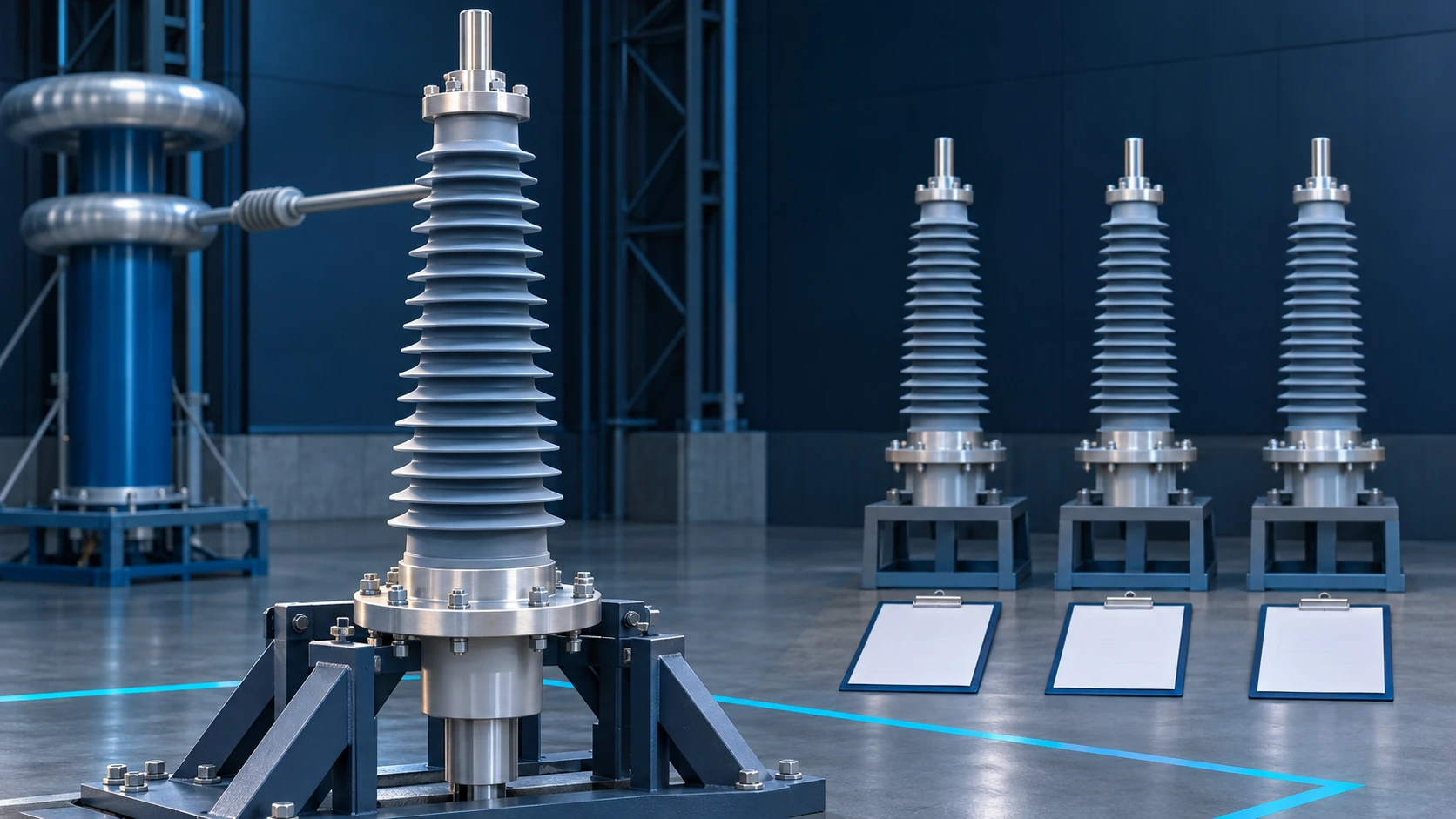
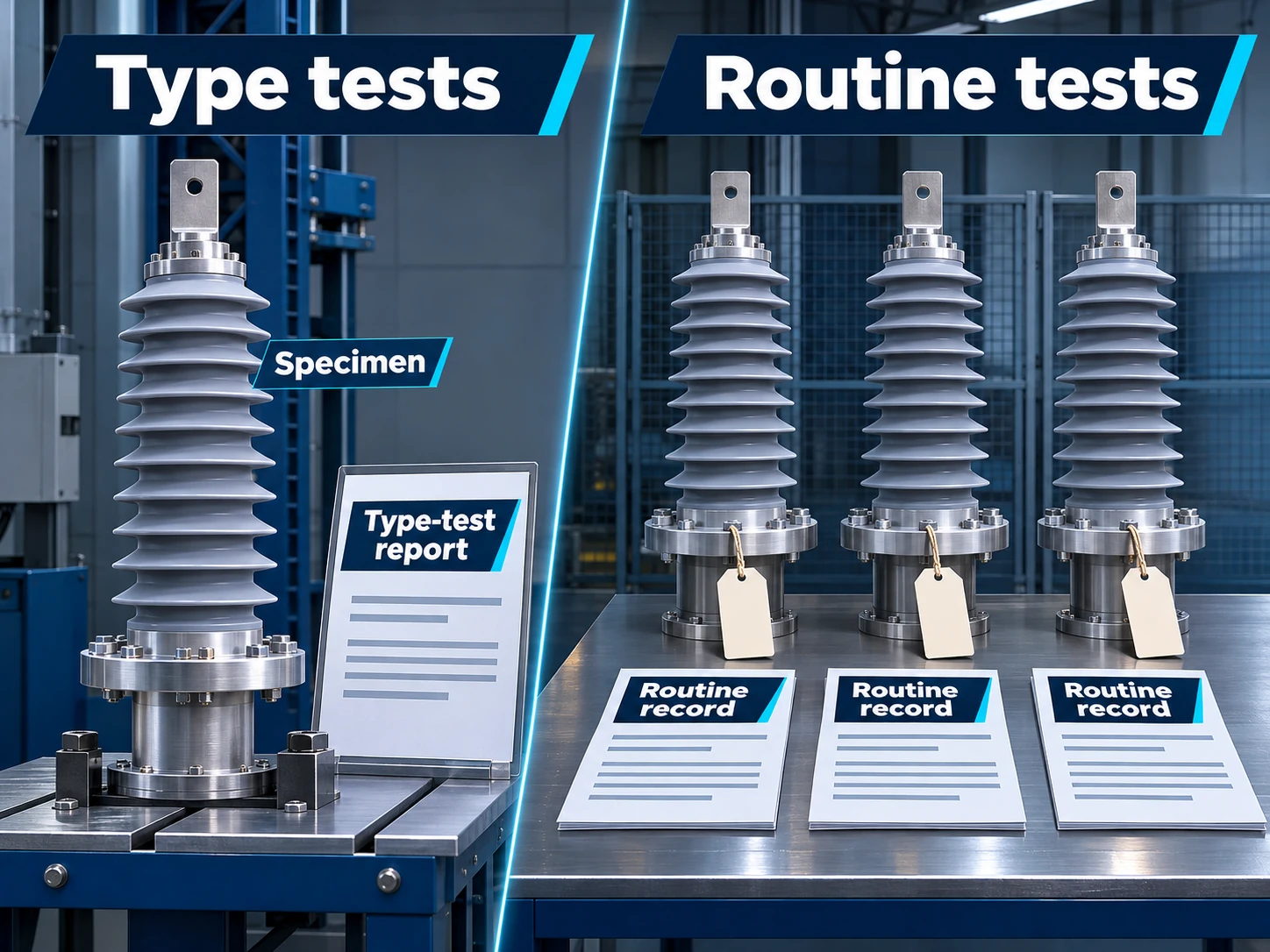
A type test proves one design specimen; each delivered production unit requires its own routine-test record.
A type test proves that one bushing design meets its ratings. A routine test proves that each bushing built to that design was made correctly. So a type-test report only helps you if its specimen matches the bushing you are buying, and every unit you receive still needs its own routine record.
- The type-test report covers one specimen. Its signed conclusion does not extend to other models or to production units.
- The routine record covers one serial number. It is the only proof that the unit in your crate passed.
- Read each test item's label. A type-test report also lists routine and special tests run on the same specimen.
- Close every mismatch in writing before you accept the bushing.
We make dry-type condenser bushings and supply both kinds of document, so this guide uses one of our own third-party reports to show what to check.
Type tests prove the design; routine tests prove each bushing
The two tests answer different questions. A type test asks: does this design meet its ratings and service conditions? A routine test asks: was this particular bushing built right?
Textbooks on high-voltage testing draw the same line. Gockenbach, in High-Voltage Engineering and Testing (2013), separates design type tests from manufacturing routine tests, and treats acceptance after transport and installation as a further stage. 2 Wagenaar's bushing chapter in Electric Power Transformer Engineering (2nd ed., 2007) says the purpose of a type test differs from checking the workmanship of each bushing produced.
| Question | Type test | Routine test |
|---|---|---|
| What it proves | The design meets its ratings | This unit was made right |
| Tested object | One specimen of the design | Every production unit |
| How often | Once per design | Every bushing |
| Document you receive | Type-test report | Routine record per unit |
Here is what each row means for you:
- What it proves. A type-test pass tells you the design can carry its ratings. It says nothing about how one later unit was assembled.
- Tested object. Our CTQC report ZJ-25.1531, for example, is labelled a type-test report on one identified FBRGL specimen.
The signed conclusion of a type-test report applies only to the tested sample. It does not certify other units or a whole product series. A clean routine record, in turn, does not show that the design was ever type-tested. You need both documents, and neither stands in for the other.
Most bushing reports follow IEC 60137, the IEC standard for testing separately supplied AC bushings at 15–60 Hz; its transformer-bushing rules also cover reactor bushings. 6 If you have not yet fixed the bushing family and ratings, start with the transformer bushing selection guide, because those ratings are what you will check the report against.
Which bushing tests are type, routine or special
IEC 60137 sorts bushing tests into three groups: type tests, routine tests, and special tests added only when the contract asks for them. Which items land in each group also depends on the bushing's voltage and construction, so read the label on each test line rather than the report title.
Three terms first. Um is the highest voltage for equipment the bushing is rated for. PD means partial discharge, a small spark inside the insulation. Tan delta is a measure of insulation loss. Our CTQC report on an FBRGL transformer bushing shows how the groups look in a real document:
| Group | Items in report ZJ-25.1531 | Depends on the bushing? |
|---|---|---|
| Type | Lightning and switching impulse, wet power-frequency withstand, long-duration AC with PD, radio interference, temperature rise, short-time current, cantilever load | Switching impulse and some others apply by voltage class |
| Routine | Tap insulation, dry lightning impulse, dry power-frequency withstand, PD, tan delta and capacitance, flange tightness, dimension check | Lightning impulse is routine only above Um 72.5 kV |
| Special | Extra temperature rise and external pressure on a partly gas-immersed bushing | Only for that construction, by contract |
Three points explain the table:
- Type tests are the severe ones. They stress the design beyond normal service, so they run once per design, not on every unit.
- Routine tests must not harm a sound unit. They are the checks every bushing can pass without damage.
- Some lines follow the construction. The flange tightness and external-pressure tests appear because that bushing is partly gas-immersed.
The edition matters too. IEC 60137:2017 made dry lightning impulse a routine test for bushings above Um 72.5 kV, so a report made to an earlier edition can show a shorter routine list. 7 Older routine lists, such as the eight-item sequence in Ellis's 2011 handbook, belong to the edition they were written for. 1
If your specification calls up the IEEE family instead, note how it is split: C57.19.00 sets general requirements and tests, C57.19.01 gives specific characteristics and dimensions, and C57.19.100 gives application guidance. 9 For an IEEE report, read the test groups from that report's own labels.
Routine items appear inside type-test reports too
A type-test report often lists routine items as well, because the lab runs them on the same specimen. Read the bracket after each test line, not the cover label. Mark each line as type, routine or special and list what is missing against your specification. That way you will not mistake routine results on a specimen for proof about production units.
Why tan delta, capacitance and PD are measured twice
Tan delta, also called dissipation factor, is a measure of insulation loss. Capacitance shows whether the condenser layers are intact. Wagenaar's chapter explains why both, plus partial discharge, are measured before and after the dielectric type tests: any damage the tests started shows up as a change.
Report ZJ-25.1531 also checks how much tan delta rises between 1.05 Um/√3 and Um. Before the type tests the rise was 0.00003 against a limit of 0.001. A rise with voltage can point to discharge activity even when the absolute value passes. For bushings of Um 123 kV and above, the factory values also go on the nameplate; the routine-record section below shows how to use them. To compare such records over time, see comparing capacitance and tan delta records.
How to check that a type-test report covers your bushing
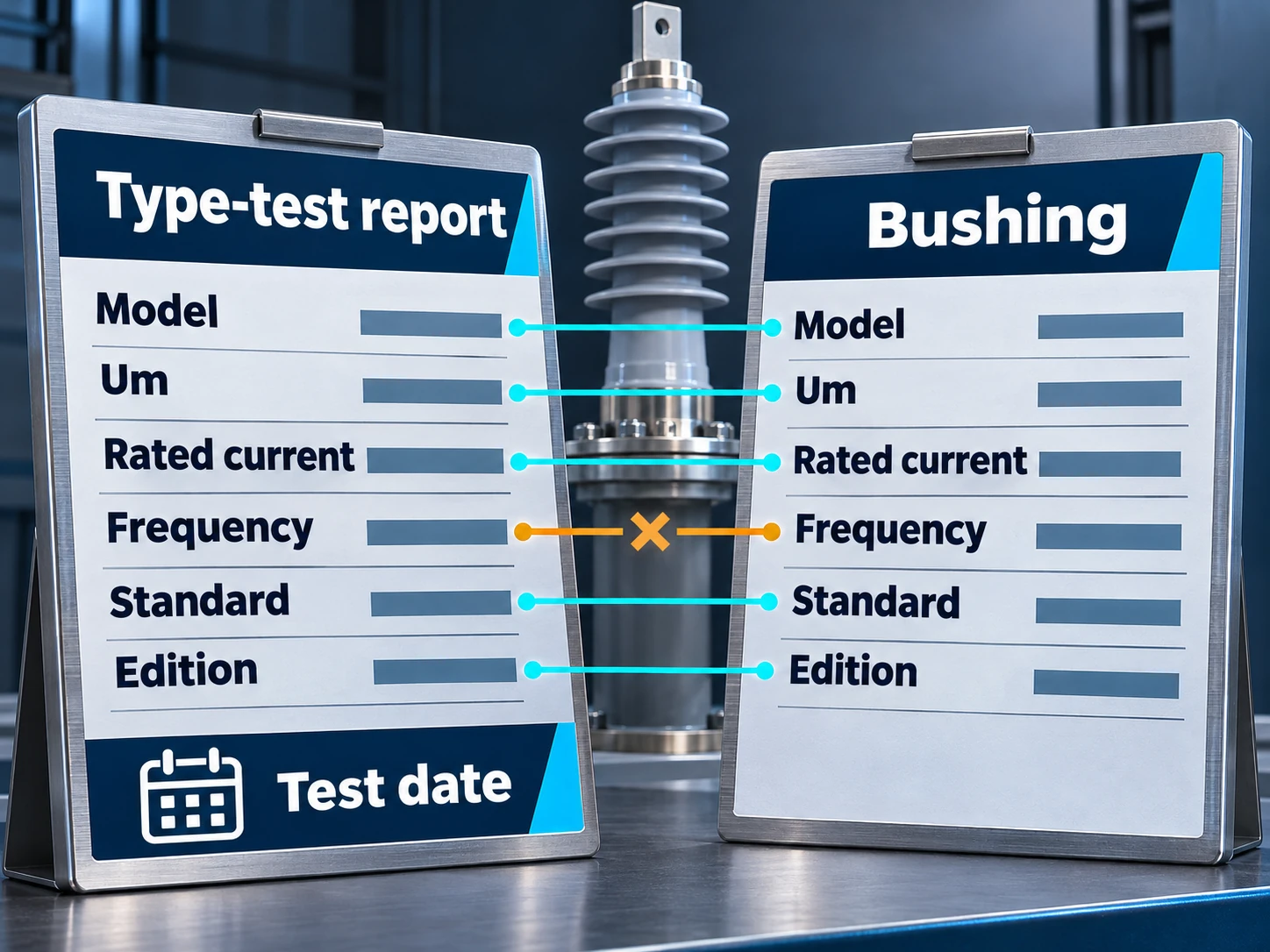
A type-test report covers only the specimen and the conditions printed in it. So the question is not whether a report exists, but how far your bushing is from that specimen. Work through the report in this order, and note every difference as you go.
Identity and specimen
Start with the report number, the issuer and the specimen model. Each CTQC report names one specimen; ZJ-25.1529, for example, covers FBRGL-126/4000 and records that this specimen passed the listed tests. A matching family name is not enough. Reports do not transfer across families either, so check the family your bushing belongs to among all six bushing families first.
Ratings, insulation levels and frequency
Next, compare the parameter page with your bushing. Report ZJ-25.1531 gives highest voltage for equipment 252 kV for its specimen. Check the rated current line next to it as well. It also gives rated frequency 50 Hz. A project at a different frequency therefore needs a written check of the thermal and current rating.
Do not stop at Um. One Um can carry different withstand levels, so compare the insulation levels actually applied. The same report records the impulse levels used, such as a corrected positive full-wave lightning impulse of 1125.9 kV. If you are buying for high current bushings, the rated current line is the one most likely to differ.
Test conditions and margins
The tests ran under stated conditions, and your service conditions may be harsher. Check four of them:
- Installation. The temperature-rise test ran with one end in air and the other in transformer oil, at the specimen's rated current. A bushing with SF6 on one side was not tested that way; see GIS bushing vs oil-SF6 bushing.
- Temperatures. The oil was at 89.5 °C and the ambient air at 31.3 °C during that test. If your transformer runs hotter oil, you are outside the tested condition.
- Margin. The hottest point, the immersed terminal, rose 60.9 K, inside the report's limit. The insulation was declared thermal class E; compare it with the insulation class of the bushing you are buying.
- Altitude. The specimen's altitude basis was up to 1,000 m. A higher site needs the external insulation checked again.
Standard, edition and test conditions
Check which standard and edition the report used. ZJ-25.1531 cites IEC 60137 edition 7 (2017-06), GB/T 4109-2022 and the technical contract. A report to an edition before IEC 60137:2017 can lack the routine dry lightning impulse now required above Um 72.5 kV, and it uses the earlier altitude correction. 7
Also check the scope. Under IEC 60137, bushings that cannot be tested on their own are tested with their apparatus, so their evidence sits in that apparatus record. 5 IEEE C57.19.00-2023 covers liquid-immersed transformer and reactor bushings and excludes bushings with gas internal insulation, so it is not the reference for GIS-type bushings. 11
Buyer rules on laboratories and report age
Your own buyer may add rules. POWERGRID's technical specification, for example, accepts type tests only from an accredited laboratory or when witnessed by the utility or its authorised representative. The same specification treats a bushing type-test report as valid for 7 years from the award, and an expired test must be repeated free of charge. Once POWERGRID has accepted a report for a type of equipment, it accepts it for later projects with the same equipment. Those are one Indian utility's rules, not IEC rules, so check what your own customer requires.
Put the specimen model and drawing reference of the covering report next to your offered model in the technical agreement. Ask the supplier to name the covering report for each offered model in the quotation. That avoids a document dispute at acceptance. Where any line differs, ask for a written applicability statement or a further test before you accept. Our quality and test evidence page shows which reports exist for which families.
What the routine-test record must show for every bushing you receive
Every delivered bushing should come with its own routine-test record, tied to its serial number. Each routine item should appear with its test voltage, its limit and the result. A record that only says "passed" does not let you check anything.
- Serial number. The record must carry the serial number on the bushing you received.
- Each routine item. Expect capacitance and tan delta, dry withstand, partial discharge, tap insulation and the other items your standard and contract list.
- Voltage, limit, result. A result without its test voltage and limit cannot be judged.
- Nameplate match. For condenser bushings of Um 123 kV and above, IEC 60137 has the nameplate carry the factory-measured capacitance and tan delta. Match those to the record; for lower ratings, match by serial number and the record itself.
Routine results printed inside a type-test report belong to the type-test specimen only. In our report ZJ-25.1531, the routine items were run on the same specimen after the type tests, so they say nothing about a production unit.
Why are the severe tests not repeated on every unit? As Gockenbach puts it, test severity should reveal defects without damaging a sound unit. 2 That is why the routine record, not a second type test, is the per-unit proof.
Our downloads page states that routine test reports accompany each delivery. You can request reports and drawings for a specific order there.
When the bushing is unpacked, check the nameplate serial number, and the capacitance and tan delta where the nameplate carries them, against the routine record. Photograph the nameplate and tick each value on the record. That catches mixed-up records before installation.
Reading bushing partial discharge and tan delta results
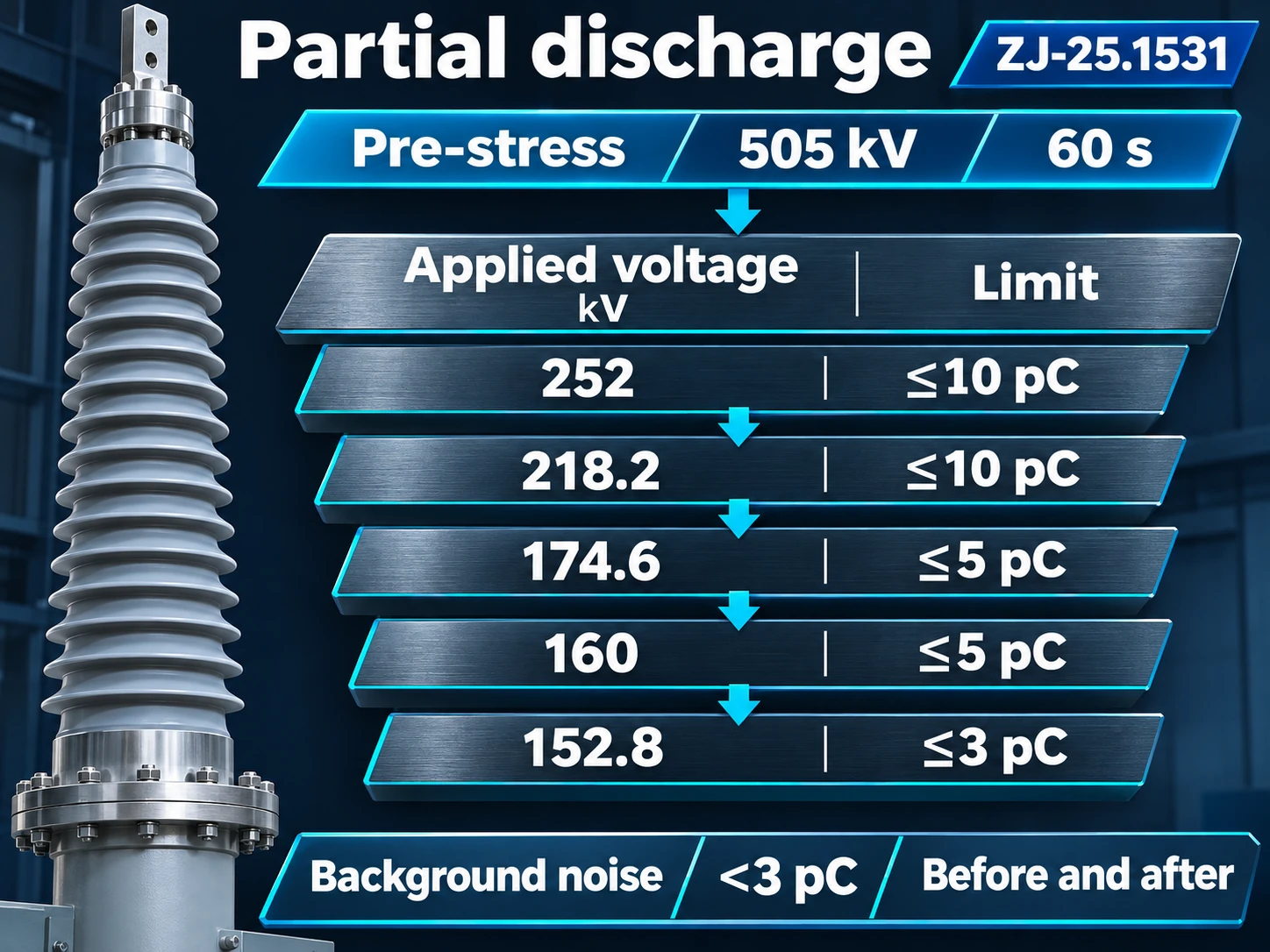
Read a partial discharge (PD) result only together with its test voltage, the pre-stress applied first, the limit at that voltage and the background noise. PD is a small local discharge inside the insulation, measured in picocoulombs (pC). A PD figure without those four facts cannot be judged.
Voltage, pre-stress and background
In report ZJ-25.1531 the specimen was first held at 505 kV for one minute, then measured on the way down. The limits tighten as the voltage falls:
| Measuring voltage | PD limit | Reading |
|---|---|---|
| Um | ≤ 10 pC | < 3 pC |
| 1.5 Um/√3 | ≤ 10 pC | < 3 pC |
| 1.2 Um/√3 | ≤ 5 pC | < 3 pC |
| 1.1 Um/√3 | ≤ 5 pC | < 3 pC |
| 1.05 Um/√3 | ≤ 3 pC | < 3 pC |
All five readings were below 3 pC. The background noise of that set-up was also below 3 pC. These entries give upper bounds. The report leaves the exact values and their relation to the actual background unspecified.
IEC 60270 defines how PD is measured as apparent charge, with the circuit and calibration. It sets no pass limit for a bushing. 8 The limit comes from the bushing standard and the contract named in the report.
Why does the PD line matter so much? In CIGRE's survey, bushings failed in 0.23% of transformer acceptance tests. 86% of those failures came in dielectric tests, with PD the largest share at 36%. 3
Tan delta and the test tap
Tan delta works the same way: read it with its voltage. Report ZJ-25.1531 reads it at three voltages up to Um and applies a limit of 0.007 at each; before the type tests the specimen read 0.00368 to 0.00378.
The same report checks the test tap separately as a routine item, and sets its own limits for that specimen: tap tan delta no more than 0.05 and tap capacitance no more than 10000 pF. The test tap is the small terminal on the flange used to measure the bushing's insulation.
Factory limits are not site limits
CIGRE TB 962 (2025) states that new-bushing factory acceptance test (FAT) values, the limits a new bushing must meet in the factory, from IEC 60137 or IEEE C57.19.01 must not be used to judge bushings in service. 4 It also says tan delta limits are valid only at 20 °C, and that there is no published acceptance level for PD on in-service bushings. 4 IEEE has likewise said its bushing test standards concern new bushings, with in-service testing interpreted under separate guides. 10
So use the factory record as the baseline for site measurements, not as the site pass line. If you want continuous PD and tan delta readings in service, see online bushing monitoring.
When the report does not cover your bushing: what to ask for
When the report does not cover your bushing, ask for three things. First, the report whose specimen does match, or a clear statement that none exists. Second, the routine record for each unit. Third, for every uncovered difference, either a written applicability statement or a further test written into the contract.
- The matching report. Our downloads page lists our CTQC type-test reports by model, including English editions available on request.
- A written applicability statement. This is quicker, but it rests on the supplier's engineering judgement. Accept it only where both sides agree the difference does not change the tested duty.
- A further test. This is slower and costs money, but it gives direct evidence. We would choose it whenever the difference changes the tested duty, such as a higher rating or a harsher service condition.
- Special tests. Under IEC 60137, tests outside the standard lists, such as seismic or pollution tests, are special tests and are run only when the contract calls for them.
Put the cost of any repeat or extra test in the contract. Buyers such as POWERGRID put repeat type tests in the price schedule: the owner may ask for a listed test to be repeated, the cost follows the contract, and an unpriced test counts as free. Write each test, who witnesses it and who pays if it is repeated into the technical agreement. That avoids disputes over unpriced retests.
A quality-management certificate does not replace any of these. An ISO certificate is not a product type test and does not stand in for one. The same report requirements belong in your bushing RFQ specification.
One design proof plus one record per unit
Accept the evidence as a set. You need one type-test report whose specimen, ratings, edition and test conditions match your bushing. You need one routine record per serial number. And you need PD and tan delta results read with their voltages and limits.
A matching title or a pass stamp cannot replace those links. Record every mismatch before acceptance, and close it with a written statement or an agreed test. Then the document review answers both questions: is the design proven, and was this unit built right?
Request the Type-Test Report for Your Model
Tell us the model you are evaluating and we will send the matching CTQC report by email, or arrange factory witness acceptance.
References
- K. Ellis, Bushings for Power Transformers: A Handbook for Power Engineers, AuthorHouse, 2011 — 2011
- M. Gockenbach, Chapter 16 in H. M. Ryan (ed.), High-Voltage Engineering and Testing, 3rd ed., IET, 2013 — 2013
- CIGRE Technical Brochure 755, Transformer Bushing Reliability (WG A2.43, 2019) — 2019
- CIGRE Technical Brochure 962, Guide for Transformer Maintenance (WG A2.69, 2025) — 2025
- IEC 60137:2017, Insulated bushings for alternating voltages above 1 000 V (IEC publication page, application scope) — 2017-06-22
- IEC 60137:2017, Insulated bushings for alternating voltages above 1 000 V (IEC publication page, scope) — 2017-06-22
- IEC 60137:2017 Edition 7.0, Insulated bushings for alternating voltages above 1 000 V (IEC publication page, summary of changes) — 2017-06-22
- IEC 60270:2025, High-voltage test techniques: Charge-based measurement of partial discharges (IEC publication page) — 2025-06-05
- IEEE C57.19.00-2023, IEEE Standard for General Requirements and Test Procedure for Power Apparatus Bushings (purpose statement) — 2023-05-15
- IEEE Standards Association, Interpretation of IEEE C57.19.01-2000 (August 2010) — 2010-08
- IEEE C57.19.00-2023, IEEE Standard for General Requirements and Test Procedure for Power Apparatus Bushings (scope) — 2023-05-15
How this guide was prepared: Prepared by ZLVOLT engineering from our CTQC type-test reports (CTQC/ZJ-25.1531 and CTQC/ZJ-25.1529), our installation guides and the standards and references listed above. The project specification, the technical agreement and the confirmed drawings decide which tests and criteria apply. Content date: November 2026.