 ZLVOLT
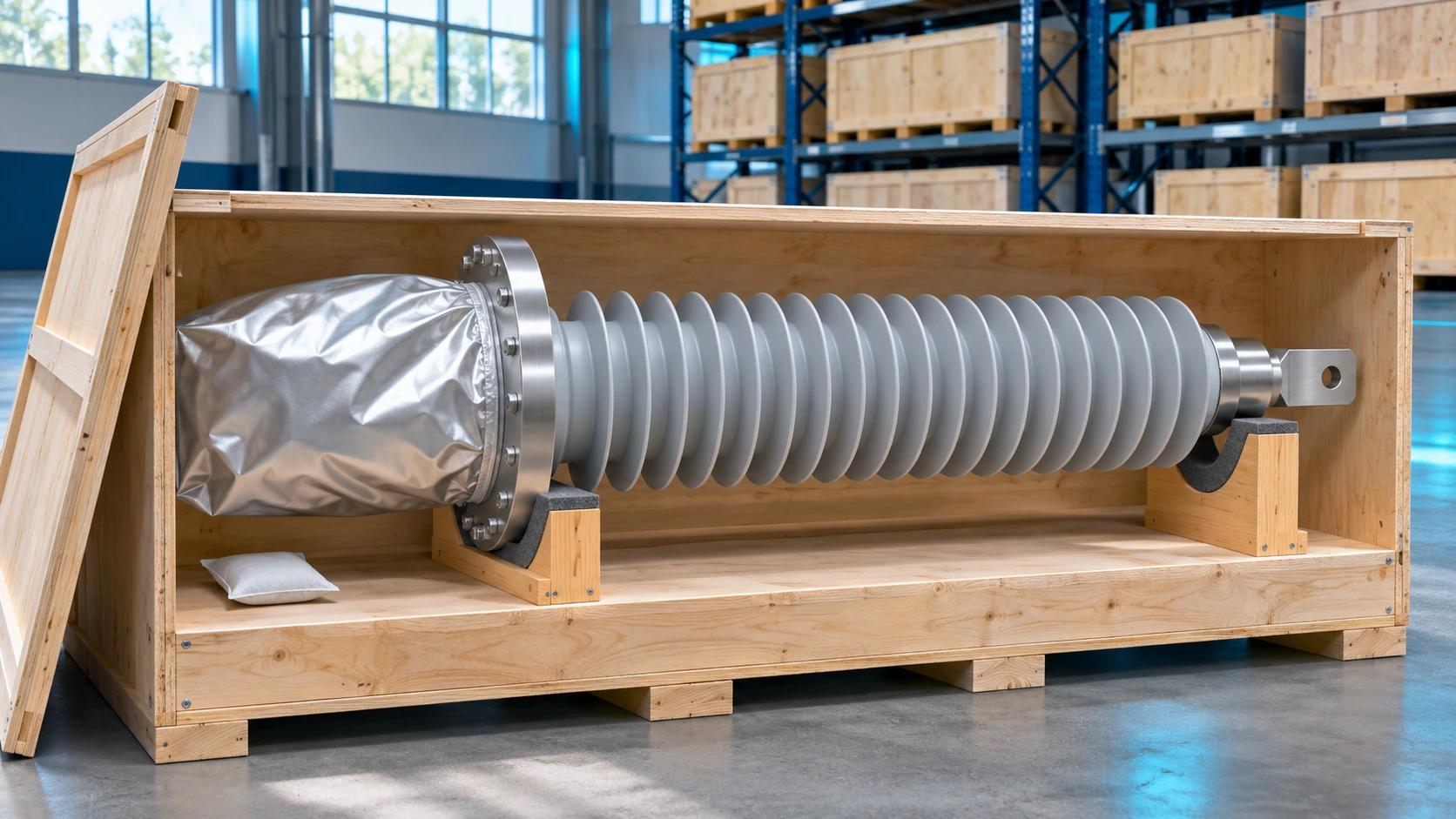
Store and move a dry bushing in its sealed original packing, set the protection by core material and waiting time, and retest capacitance (how much charge the core holds) and tan delta (how much energy the insulation loses) before it is installed. IEEE puts the manufacturer's storage instructions first. 3 Poor storage can spoil a good bushing without anyone noticing until the test set is connected.
- Short wait. IEEE treats the original crate as adequate for up to 6 months. 3
- RIP in closed packing. CIGRE TB 755 allows at most 1 year in unopened factory packing. 1
- If damp or long storage has pushed tan delta over its limit. Our transformer and GIS guides dry the bushing at 60 °C for 24 h before a retest.
These rules are for dry RIP (resin-impregnated paper) and RIF (resin-impregnated fibre) condenser bushings. Our own rules are those printed in our two guides: one for transformer bushings, and one for bushings of gas-insulated switchgear (GIS), the metal-enclosed switchgear filled with SF6 gas. Read the one that matches your bushing; other makers' bushings follow their own instructions. For the other guides, see our bushing knowledge hub.
How Long and How Should a Dry Bushing Be Stored?
Three things decide the answer: the core material, whether the original packing is still sealed, and how long the bushing will wait. The manufacturer's instructions come first.
Short Storage and Long Storage Side by Side
Short storage means leaving the packing closed. Long storage means building a new barrier before the old one fails.
| What to settle | Short wait, packing still closed | Long wait, planned in advance |
|---|---|---|
| How long | Up to 6 months in the original crate (IEEE Std C57.19.100-2025) 3 | Over 1 year counts as long-term (CIGRE TB 755, 2019) 2 |
| Place | Dry, away from sunlight and animals (TB 755) 2 | Metal rack, indoors or covered, so it can be tested (IEEE) 3 |
| Oil end | Wrapped in film with desiccant, above all for RIP (TB 755) 2 | RIP: sealed aluminised bag with desiccant, or dry mineral oil in a metal container (TB 755) 2 |
| Position | As the maker's guide allows | Vertical on a stand designed for earthquakes, connection faces greased, a cover on top (TB 755) 2 |
Desiccant is the drying agent packed with the bushing. The oil end is the lower end that will sit in the transformer oil. Between 6 months and 1 year, the sources do not agree.
Which Period Applies When the Sources Differ
Read the instructions for the bushing in front of you. IEEE says that its 6 months is a general figure and that the manufacturer's storage instructions take precedence. 3 The US Bureau of Reclamation (USBR) says the same for all bushings in its FIST 3-2 manual of 1991. 8
For our bushings the guides set how to store. Agree the period with us, and treat 6 months as the date to ask, and not as a shelf life. SP Energy Networks, a UK network operator, asks its staff to contact the transformer supplier when storage beyond 6 months is expected. 7 The special packing it mentions is foil bags with moisture indicators.
The 1 year in TB 755 is for an RIP bushing whose factory packing has not been opened. 1 Once the sealed film has been opened, that period no longer describes your bushing. An arrival check that leaves the film sealed does not open it.
When the bushing goes into store: write the arrival date, the date to ask the maker and the person responsible on the crate and in the stock record. An expired packing is then found on that date, long before the bushing is needed.
Standing or Lying Flat
For our dry bushings both positions are allowed. Our GIS guide lets the bushing stand or lie flat, with no load on the sheds, the flexible silicone skirts around the outside. It also lets the closed crate stay outdoors under a tarpaulin. Our transformer guide follows the same storage rules and protects the hollow grading ball, the metal shield at the oil end, separately.
Where a utility sets stricter rules for its own site, keep them. SP Energy Networks wants bushings indoors in their original film and crates, and never outdoors unprotected from rain and humidity. 7
Two other rules are often copied onto dry bushings by mistake. TB 755 advises tilting a bushing by at least 10 degrees to keep its paper in oil. 1 The ban on horizontal storage in USBR FIST 3-2 (1991) covers liquid- and plastic-filled bushings, because a void can form in the filler. 8 IEEE Std C57.93-2019 asks for the upper end of loose bushings to be raised in the crate, in a guide for liquid-immersed transformers. 4 If your dry bushing's guide does not ask for a tilt, do not add one.
Expecting a long wait between delivery and installation? Send the model and the planned storage time, and we will confirm how it should be stored.
What Should You Check When the Bushing Arrives?
Inspect before anything is lifted out. Arrival is the one point where transport damage can still be told apart from damage in store. Our transformer guide puts this check ahead of lifting and unpacking.
What to Look At and Write Down
Decide first where the bushing goes next, because that sets how far you open it.
- Into store. Open the crate lid if the instructions allow it, and stop at the sealed film. Check through the film. Leave the film and its desiccant closed.
- Straight to installation. Open the film too, and look at every surface.
- Film already open or wet. Treat it as a finding, and ask the supplier before you reseal anything.
Use one sheet per bushing and fill it in at the crate.
| Item | What to look for | What to record |
|---|---|---|
| Crate and closures | Breaks, wet wood, opened lids | Photographs of every side and the labels |
| Film and desiccant | Tears, water inside the film, spent desiccant | Sealed or open, and any change |
| Transport indicator, if fitted | Its state, read by the instructions that came with it | State, time and the instruction used |
| Identity | Model and factory serial number | Both, as printed |
| Data plate | Capacitance and tan delta | Both values, as the baseline for later checks |
| Lifting parts | For our GIS bushings, the lifting rings, plates and wrench packed with the bushing | Received or missing |
| Papers | The storage instructions | Received, or asked for and when |
| Visible surfaces | Sheds, flange, terminals and oil end, through the film or after it is opened for installation | Each finding with its place on the bushing |
The data plate is the metal plate with the factory test values. SP Energy Networks, the UK network operator, checks the packing and the condition of the desiccant 7 and checks later readings against the data plate. 7 Copy it on day one, or take it from the test report if the plate is out of sight.
Photograph the closed crate, its labels and any indicators before a lid is opened. Repeat for each layer you do open, with the serial number in the frame. The carrier and the maker then look at the same evidence.
When the delivery is booked in: write on the sheet the one person who may open the crate, and keep it closed until that person has signed the photographs. Nobody opens the evidence before it is recorded.
If the model in the crate is a wall bushing, its two ends and its fixing are shown on the wall bushings page.
Normal Traces and Real Warning Signs
Two of these findings are easily misread. The third is a real sign.
- A little oil at the ends. By our GIS guide, traces of test oil or thread grease at the ends of a GIS bushing are normal, because each one was routine-tested in oil.
- Oil on the sheds. This one needs action. Our transformer guide has transformer oil wiped off silicone sheds at once with an alcohol cloth.
- A pale oil end. On a bare RIP oil end, CIGRE TB 755 reads a lighter colour with visible paper texture as a sign of moisture. A dry one is dark, with almost no paper grain. 2
When to Stop and Ask
Keep the packing as it is and ask the supplier when you see any of these:
- The crate is broken or wet inside.
- There is water in the film, or the desiccant is spent.
- A transport indicator has changed.
- The body, the sheds or the terminals are damaged.
- A bare oil end looks damp.
Two other findings do not stop the delivery. If the storage instructions are missing, SP Energy Networks asks for them at once. 7 If the project delay is likely to pass 6 months, it contacts the supplier about special packing. 7 In both cases the film stays sealed and the crate goes into dry indoor storage.
Delay is the quiet one. The same utility found that project delays and problems during post-delivery checks left RIP bushings on site longer than planned, and that poor storage can let moisture into the paper until a bushing is unfit for service. 7
What to ask for before the order, so that the instructions arrive with the crate, is in our guide to transformer bushing RFQ specification.
How Do You Lift, Repack and Ship It Again?
Lift only by the parts the maker provides for lifting. Everything else on the bushing is either soft, plated or sealed.
Lifting the Crate and the Bare Bushing
Lifting the packed crate and lifting the bushing out of it are two operations. Our transformer guide and our GIS guide each show them as separate arrangements. Use the figure for the operation in front of you. This page does not replace it. Without the guide or the marks on the crate, ask before you lift.
The packed crate. Sling it only at the points marked on the crate or drawn in the guide, keep it level and the right way up, and set it down on firm, even ground. Look for the marks before the truck leaves, so that missing ones can still be asked for.
The bare bushing.
- Read the model. Match the bushing to the lifting figure in its guide, and check that the lifting parts from the crate are there.
- Take off the hollow grading ball. On our transformer bushings it comes off before the lift. It is the shield that evens out the electric field at the oil end.
- Keep load off the silicone sheds. They must not carry any force.
- Use the lifting plate. Slinging without one is for porcelain housings only, on our transformer bushings and on our GIS bushings.
- Watch the sling angle. With the adjustable lifting plate on our GIS bushings, the tensioned sling stays perpendicular to the plate, so that the end fitting does not turn and damage the seal.
- Guard the lower end. Keep the oil end, or the enclosed end of a GIS bushing, clear of the crate and the floor while the bushing is turned and lowered. Let nothing rest on it.
- Short the bushing. A condenser bushing is a capacitor. CIGRE TB 755 advises shorting the conductor to the flange when it is moved, because a shock can make someone fall. 2
Between moves, USBR FIST 3-2 asks for stored bushings to be kept where they cannot suffer mechanical damage. 8
Repacking and Shipping It Again
A bushing that goes back on a truck needs the same protection as on its first trip.
- Silver-plated parts. Grease them, wrap them in film, then in light-proof paper. Both our guides ask for this.
- Hollow grading ball. On our transformer bushings, protect it separately and label it not to bear load.
- Position. Lay the bushing horizontally. Our GIS guide places it in the crate's support cradle. Our transformer guide also transports it horizontally.
- Oil end. Put a sealed barrier with desiccant back on an RIP oil end. CIGRE TB 755 describes an aluminised bag. 2
- Crate. If the original crate is gone, ask the maker for the packing drawing before the bushing moves.
Put the bushing back on the same cradle supports it arrived on. Photograph them when the crate is first opened, because that picture is the packing drawing you will have on the day. Neither the sheds nor the oil end carries the bushing. Standing or lying is a choice in store. On the road it is not.
If the bushing may be moved or returned later: keep the crate, cradle, film and labels dry and together with the serial number. The instructions for one model can be requested on our document request page.
What Do RIP and RIF Cores Each Need in Storage?
The oil end of an RIP bushing is the weak point, so it gets the strictest barrier. Other threats, from sunlight to mice, reach any dry bushing.
RIP, RIS and RIF: What Is Known About Moisture
RIP means resin-impregnated paper, so its core contains cellulose paper. RIF means resin-impregnated fibre: the core is wound from glass fibre, without paper. Paper is what makes the difference. A 2023 study in IET Generation, Transmission & Distribution tested laboratory discs of one E51 epoxy recipe. Epoxy-impregnated paper took up 3.26% water at saturation, against 0.99% for the epoxy alone. 5 Those are sample values and describe no finished bushing. 5
| Core | What CIGRE TB 755 says | What to do |
|---|---|---|
| RIP, with paper | The machined oil end leaves paper fibres open. Moisture travels deep along the layers, where it is almost impossible to remove, and tan delta can rise within months even indoors 2 | Keep the oil end sealed: an aluminised bag with desiccant or a metal container of dry mineral oil 2 |
| RIS, with a synthetic layer | The layers do not absorb moisture, but long-term practice is not yet proven and the oil end still needs protection from ultraviolet light 2 | Seal and shade the oil end all the same |
| RIF, with glass fibre | The RIS statement is not about RIF and does not carry over | Keep it sealed and dry, as its guide asks |
RIS is resin-impregnated synthetic, a third dry type. Its good record on moisture is often quoted for every paperless core. CIGRE TB 755 wrote it about RIS. For RIF, the safe reading is simple: keep the packing closed, and when RIP and RIF share a store, use the RIP rule for both.
A bare RIP oil end is the case to avoid. TB 755 reports that it takes up moisture within months and that tan delta rises. 1 USBR FIST 3-2 asked for the same thing in 1991: exposed paper on the lower end needs an oil tank or moisture-proof wrapping. 8
More on the two core materials is in RIP vs RIF bushings.
What to Protect on Any Dry Bushing
A bushing is built to sit in a liquid or a gas. Out of it, the surfaces meet air, moisture and ultraviolet light. 3
- Oil end. Keep it covered and dark. TB 755 notes that most RIP oil ends need shielding from ultraviolet light too. 2
- Centre tube. In a draw-lead or draw-rod bushing, the winding lead or a pull rod runs through a hollow tube in the middle. TB 755 has that tube plugged, because insects nest in it, and gaskets and polymers protected from ultraviolet light and ozone. 2
- Sheds. Nothing rests on them. Our transformer guide forbids any load on them, and our GIS guide forbids load on them when the bushing lies flat.
- Animals. TB 755 records a case at a 400 kV substation in Central Europe: rodents chewed the silicone sheds of a bushing kept indoors in its original film for about 10 years, with severe damage to the creepage path, the insulating path along the outside surface. 2 Film is a moisture barrier. It stops nothing with teeth.
What to Check and How Often
| Check | How often | Who asks for it |
|---|---|---|
| Packing and desiccant | Regularly | SP Energy Networks 7 |
| Mechanical damage and power factor | Periodically | USBR FIST 3-2 8 |
| Capacitance and tan delta | Every 4 years in store, recommended | CIGRE TB 755 2 |
| Oil container, if one is used: moisture and breakdown voltage of the oil | Every 4 years, with that retest | CIGRE TB 755 2 |
| Breather of that container | Regularly, no fixed interval | CIGRE TB 755 2 |
Power factor is another measure of insulation loss, read the same way as tan delta. The breakdown voltage of the oil shows how much voltage it can stand, and the breather is the vent that lets the container breathe through a drying agent. Put your own dates on the first two lines, because a check without a date is easily skipped.
At every storage check: log the desiccant as well as the crate. Write down its condition, the state of the bag or container, and who resealed it. That shows when the barrier was last known to be dry.
How Do You Tell It Is Damp, and Can It Be Dried?
Suspect moisture when the barrier was broken, when a bare RIP oil end has turned pale, or when tan delta has risen above its value before storage. Some damp bushings can be dried. The procedure depends on the bushing, and there is a point where you stop.
Is It Moisture, Dirt or the Connection?
Dirt and poor contacts raise the reading as well, and they are the cheapest to rule out. Tan delta is the share of energy the insulation loses, so anything that leaks current adds to it, and so does water in the paper.
- Clean and dry the surfaces that are in the measuring path.
- Check the leads and the contact at the test tap, the small terminal near the flange that is used to measure the insulation.
- Let the bushing reach a steady temperature, then repeat the reading.
- Compare it with the value before storage and with the data plate.
- Look at the oil end. On an RIP bushing, TB 755 reads a lighter colour and visible paper structure as signs of moisture. 2
How far can storage move the value? In a June 2024 presentation to the CIGRE US National Committee, Dennis Albert reported a 220 kV bushing that went from 0.25% to 0.85% tan delta after 6 months outdoors. 9 That is a single case, with the insulation type, test temperature and connections not stated. 9 Take it as a reason to retest. It is not a rate you can apply.
Whether two readings can be compared at all, and what limits apply, is covered in comparing capacitance and tan delta records.
Two Published Drying Schedules
Two schedules are in circulation. They differ in temperature, time and repetition. Follow one of them as a whole, and do not mix or rank them.
| Our guides | CIGRE TB 755 (2019) | |
|---|---|---|
| Schedule | 60 °C for 24 h | 70 to 80 °C for 3 to 4 days 1 |
| For | Our RIP and RIF transformer bushings and GIS bushings, when humid weather or long storage has pushed tan delta over its limit | RIP bushings that have taken up moisture |
| Then | Test again | Usable if tan delta comes back; vacuum may be added 2 |
| If the retest fails | Confirm with us before a second cycle | Dry and test once more; scrap if it still fails 1 |
TB 755 gives working-group recommendations for RIP bushings in general and puts the manufacturer's instructions first. 1 So follow the instructions for the installed model, and do not raise our 60 °C to 80 °C because another document allows it.
Before anyone starts an oven: write down the model, the clause, the temperature, the time and who approved it. Read capacitance and tan delta before and after. Outside the maker's procedure, the record is worth little.
When to Stop
One reading taken while the bushing is drying cannot decide. In a 2021 IEEE iSPEC paper, samples of epoxy-impregnated paper tested at 200 V and 50 °C showed tan delta at power frequency falling first and rising later as drying went on. 6 Let the bushing cool to the temperature of the earlier test, then repeat the measurement.
If the value still does not come back, stop the installation and contact the manufacturer. TB 755 warns that moisture which has gone deep along the paper is almost impossible to draw out. 2 SP Energy Networks sends bushings beyond the manufacturer's limits back for factory drying and full re-certification. 7 The delay is visible on the schedule. A damp bushing under transformer oil is visible to no one.
What Must Be Done Before Installation and Energising?
Test before the bushing is mounted, compare with a known record, and take the waiting time from the guide of the bushing you installed.
Tests Before Mounting
Readings taken on the assembled transformer include the bushing, as Dennis Albert noted in his 2024 presentation, so a change is hard to place. 9 Measure first, then mount. CIGRE TB 755 asks for capacitance and tan delta before service 1 and expects values close to those before storage. 2 USBR FIST 3-2 asks for the power factor of a stored bushing before it goes into service. 8
| Release check | Value in our guides | Compare with |
|---|---|---|
| Tan delta, measured dry | Not above 0.7% | The data plate and the reading before storage; on GIS bushings also no significant change against earlier results |
| Capacitance, transformer and GIS bushings (measured dry on GIS bushings) | Investigate a change of more than 5%, up or down, from the initial value | The initial value on the data plate |
| Test tap to earth | At least 1000 MΩ at 2500 V | The limit; on GIS bushings also no significant change against earlier results |
| Tap before voltage, GIS bushings | Cap or test adapter fitted, because the tap is not self-grounding | Seen and signed |
The first three limits are the same for our transformer and our GIS bushings. On our GIS bushings a value inside the limit is not enough by itself: the GIS guide also asks for no significant change against earlier results. A project agreement or a confirmed drawing can set tighter values. The data plate answers whether the bushing is still within its limits; SP Energy Networks compares with it before assembly. 7 The reading before storage answers what the wait has done. If there is none, compare with bushings of the same type and history.
If a wall opening or a changed connection means that the stored bushing no longer fits, go back to transformer bushing selection before anything is drilled or adapted.
Which Waiting Time Applies
Published waiting times differ. The guide for the installed bushing governs.
| Source | Wait before energising | Applies to |
|---|---|---|
| Our transformer guide | 6 to 24 h after conventional oil filling, so that bubbles leave the oil end | Our transformer bushings |
| Our transformer guide | No standing time after vacuum oil filling | Our transformer bushings |
| CIGRE TB 755, general recommendation | 1 to 2 days after installation 1 | RBP and RIP transformer bushings |
TB 755 calls its wait soak time: the bushing is left to rest after installation. RBP is resin-bonded paper, an older dry type. Use the TB 755 figure where the maker's guide is silent, and do not add it to our times.
For two cases the wait depends on the model: standing up a bushing that was shipped or stored flat, and filling a GIS enclosure with gas. Follow the model's manual, and confirm with the manufacturer where it states no time.
At handover to the installation crew: attach the arrival record, the checks in store and the readings before mounting to the bushing file. The next fault investigation then starts from a known baseline.
Keep the Pack Sealed, Check on a Date, and Retest Before Service
Storage comes down to three habits.
Keep the pack sealed. The barrier does more for the oil end and the sheds than any later treatment. Check on a date. A period printed in one document is not the period of another, and packing fails quietly. Retest before service. Only a comparison with the data plate or with the value before storage shows what the wait has done.
Around those habits sit a few firm rules. Lift by the parts made for lifting, and keep load off the sheds. Ship the bushing flat in its cradle. Dry it only by the procedure for the bushing in front of you. Ask the maker early when the plan changes, because before the period runs out there are still several good options.
When the arrival record, the dated checks and the retest are in one file, the bushing can be handed over with nothing left to guess.
References
- CIGRE TB 755: Transformer bushing reliability (WG A2.43) — 2019
- CIGRE TB 755: Transformer bushing reliability (WG A2.43), storage chapter — 2019
- IEEE Std C57.19.100-2025 Guide for Application of Power Apparatus Bushings (Clause 10.5.1) — 2025
- IEEE Std C57.93-2019 Guide for Installation and Maintenance of Liquid-Immersed Power Transformers — 2019-05-29
- Study on water absorption and dielectric response of epoxy resin impregnated paper bushing (IET Generation, Transmission & Distribution, 2023) — 2023
- Research on Diagnosis of Damp State of Smart Transformer Dry Type Bushing (iSPEC 2021) — 2021
- SP Energy Networks: Inappropriate Storage of HV Transformer Bushings of the RIP Type (EXP-11-231) — 2017-11-27
- USBR FIST 3-2 Testing and Maintenance of High-Voltage Bushings, Section V — 1991-11
- Dennis Albert: Power transformer diagnosis and DC bias (CIGRE US National Committee GOTF, June 2024) — 2024-06
How this guide was prepared
Prepared by ZLVOLT. Based on 9 cited sources listed in References. Content date: 2026-11-26.